Zero Trust for Agentic AI
Most developers building AI agents ask the same question: how do I make this more capable?
The more important question is harder: how do I ensure it remains safe when everything around it becomes hostile?
That mindset shift is what Zero Trust demands. And applying it to agentic AI is not optional anymore, it is the architecture.
This playbook applies Zero Trust principles to autonomous agents, agentic workflows, MCP-enabled systems, and multi-agent architectures. It draws from IBM’s Zero Trust framework, IBM AI Security guidance, and OWASP’s Top 10 for LLM Applications.
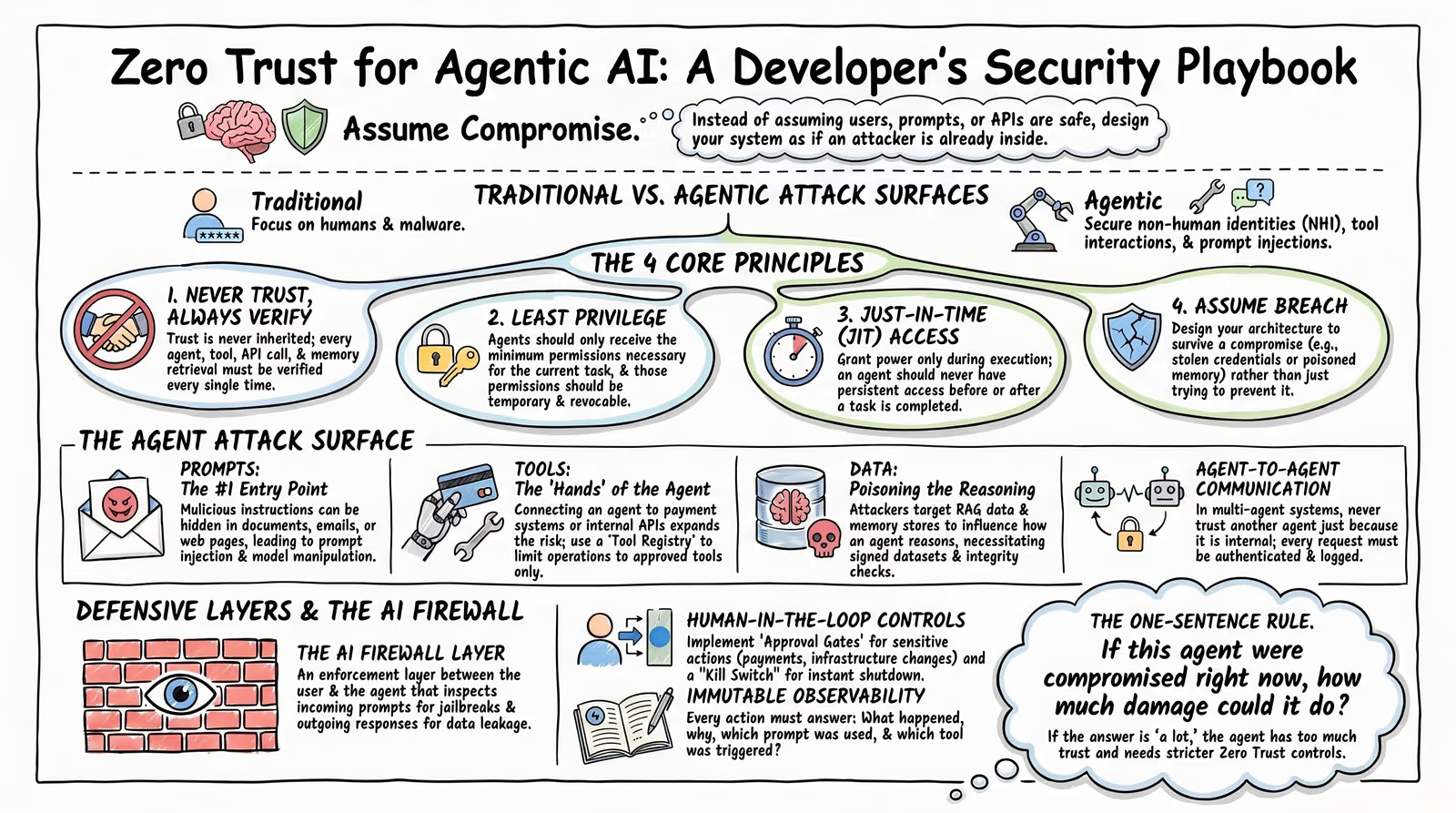
The core mindset: assume breach
Traditional security assumes a perimeter.
Zero Trust assumes the perimeter is already compromised.
For AI agents, this means refusing to assume:
- Prompts are safe
- APIs are trustworthy
- Tools are legitimate
- Credentials stay secret
- Memory has not been tampered with
An attacker is already somewhere inside the system. Design accordingly.
What changes with agentic systems
Zero Trust was originally built for humans, devices, and networks. Agents expand every category of that model.
| Traditional | Agentic |
|---|---|
| Users | Human + AI agents |
| IAM | Human IAM + Non-Human Identity (NHI) |
| Applications | Tools, APIs, MCP servers, agents |
| Databases | Training data, RAG data, memory stores |
| Network traffic | Agent-to-agent and agent-to-tool communication |
| Malware | Prompt injection, tool poisoning, model manipulation |
| Privileged accounts | Agent credentials and service accounts |
The security principles stay the same. The attack surface becomes much larger.
The four Zero Trust principles, applied to agents
Never trust, always verify
In traditional systems, this means verifying user identity, device health, and network access. In agentic systems, it means verifying every agent, every tool, every API call, every memory retrieval, and every model interaction.
Trust should never be inherited. Every request must earn it.
Least privilege
An agent should receive only the permissions necessary for the current task not the role, not the project, not the team.
Bad:
Travel Agent
- Read CRM
- Access Finance
- Send Emails
- Buy Products
- Access HR

Good:
Travel Agent Current Task
- Read travel database
- Create itinerary
(nothing else)
Permissions must be temporary, scoped, and revocable. Never permanent. Never broad.
Just-in-time access
Most organizations grant permissions “just in case.” Zero Trust grants them “just in time.”
Agent requests capability
  → Policy engine validates
  → Temporary credential issued
  → Task completed
  → Credential expires
The agent should have power only during execution. Never before, never after.
Assume breach
Design every agent as if its credentials are already stolen, its prompts are being manipulated, its APIs are compromised, its memory has been poisoned, and its MCP servers are malicious.
Security architecture should survive compromise rather than merely attempt to prevent it. That is the difference between fragile and resilient.
The agent attack surface
A typical agent pipeline looks like this:
Input → Reasoning → Policies → Memory → Tools → ActionsEvery component can be attacked.
Attack surface 1: Prompts
Prompt injection is the #1 risk identified by both IBM and OWASP.
An attacker does not need to break into your system. They inject malicious instructions into content the agent reads:
- Documents
- Web pages
- Emails
- PDFs
- GitHub issues
- RAG content
The agent interprets it as a command. The result can range from information disclosure to unauthorized action at machine speed.
Controls: Prompt filtering, AI firewalls, context isolation, input validation, instruction hierarchy, and human approval for sensitive actions.
Attack surface 2: Tools
Tools are the hands of an agent. A harmless model becomes dangerous once connected to payment systems, cloud infrastructure, internal APIs, or customer databases. Every tool you add expands the blast radius.
Controls: Maintain a tool registry with approved tools only. For each tool, track owner, risk level, allowed agents, allowed operations, and audit history. Never allow arbitrary tool discovery in production.
Attack surface 3: Credentials
Never embed credentials inside source code, prompts, agent memory, or configuration files. Every agent should have its own identity.
Controls: Secret vaults, dynamic credentials, short-lived tokens, and rotating secrets. An agent that holds credentials permanently is a standing liability.
Attack surface 4: Data
Agentic systems depend heavily on data training data, RAG content, memory stores, user preferences, context windows. Attackers target data because data influences reasoning.
The two key risks are data poisoning (modifying the knowledge base so the agent learns bad behavior) and context poisoning (injecting persistent malicious instructions into the agent’s context window).
Controls: Signed datasets, data integrity checks, source validation, memory expiration, and data provenance tracking.
Attack surface 5: Models
Models can be attacked through fine-tuning poisoning, backdoored checkpoints, malicious model files, and supply-chain compromise.
Controls: Trusted model sources only, verified signatures, security scanning, and red-team testing before deployment. Treat models like executable software because they effectively are.
Attack surface 6: Agent-to-agent communication
Multi-agent systems create a new class of lateral movement risks. If one agent in a chain is compromised, it can issue false instructions, exceed its authority, or exfiltrate data through the pipeline.
Controls: Every agent must have a unique identity and unique permissions, authenticate every request independently, and log every interaction. Never trust another agent simply because it is internal.
The five pillars of agentic Zero Trust
IBM and CISA’s Zero Trust model defines five pillars. Here is what each means for agents.
Identity: Who is making this request? Human, agent, or sub-agent? Every principal needs a unique identity, strong authentication, and credential rotation. Non-human identity management is not optional.
Devices and runtime: Where is the agent running? Is the environment trusted? Has it been modified? Runtime monitoring, container security, endpoint validation, and supply chain verification all apply.
Network: Encryption everywhere, service authentication, microsegmentation, and east-west traffic monitoring. Agent communication should never be implicitly trusted, even on internal networks.
Applications and tools: Tool registry, API validation, tool permissions, and secure MCP integrations. Every tool invocation should be inspected before it executes.
Data: Encryption, access control, provenance tracking, DLP controls, and data classification. Agents should not access data simply because it exists.
The AI firewall
One of the most practical additions to an agentic architecture is an enforcement layer between user, agent, and tools.
An AI firewall handles three jobs:
Incoming inspection: Detect prompt injection, jailbreak attempts, and data exfiltration requests before they reach the agent.
Outgoing inspection: Detect sensitive data leakage, unauthorized actions, and dangerous API calls in the agent’s output before they reach downstream systems.
Policy enforcement: Block high-risk operations, unauthorized tool usage, and actions that exceed the agent’s defined authority.
Observability and auditability
If you cannot explain why an agent acted, you do not control it.
Every agent action must be answerable: what happened, why, which prompt triggered it, which memory was retrieved, which tool was called, which credential was used, and which policy applied.
This requires immutable logs, full traces, agent decision records, tool execution records, memory retrieval records, and security event correlation. It is not just good engineering it is essential for compliance, incident response, and building the kind of trust that lets you expand agent autonomy responsibly.
Human-in-the-loop controls
Autonomy is not the goal. Controlled autonomy is the goal.
Every production agent system should have:
- Kill switch instant shutdown capability
- Approval gates human sign-off for payments, deployments, data exports, and infrastructure changes
- Rate limits prevent infinite loops, mass purchases, and resource exhaustion
- Canary deployments test agents in limited environments before full release
OWASP Top 10 for LLM applications
These map directly to the attack surfaces above:
| Risk | Description |
|---|---|
| Prompt injection | Agent manipulated by malicious instructions |
| Insecure output handling | Agent output triggers dangerous downstream actions |
| Training data poisoning | Compromised model behavior |
| Sensitive information disclosure | Data leaks through responses |
| Supply chain vulnerabilities | Compromised models, libraries, plugins |
| Excessive agency | Agent has too much power |
| Overreliance | Humans trust outputs blindly |
| Model theft | Unauthorized model access |
| Vector and embedding weaknesses | RAG manipulation |
| System prompt leakage | Exposure of internal instructions |
Secure agent development checklist
Before shipping any agent:
Identity
- Unique agent identity
- No shared credentials
- MFA where applicable
Permissions
- Least privilege enforced
- Just-in-time access
- Temporary credentials only
Secrets
- Vault-managed
- Rotated on schedule
- Never hardcoded
Inputs
- Prompt validation
- Content inspection
- Injection protection
Tools
- Registry approved
- Access controlled
- Audit trail enabled
Data
- Encrypted at rest and in transit
- Classified by sensitivity
- Integrity verified
Models
- Trusted source only
- Scanned before use
- Red-teamed before production
Monitoring
- Full tracing enabled
- Immutable logs
- Alerts configured
Human controls
- Kill switch available
- Approval gates for high-risk actions
- Rate limits enforced
Testing
- Prompt injection testing
- Adversarial testing
- Red-team exercises scheduled
The one-sentence rule
Whenever you design an AI agent, ask:
“If this agent were compromised right now, how much damage could it do?”
If the answer is “a lot” the agent has too much trust.
Zero Trust for AI is not about distrusting AI. It is about ensuring that every identity, every action, every tool, every credential, every piece of data, and every decision is continuously verified, minimally privileged, observable, and controllable.
That is how autonomous systems remain aligned with human intent while operating at machine speed.