Fine-Tune LFM3, a Large Language Model, into a Decision Model with Unsloth: Lead Qualification with Claude Code over MCP
Page 2 of 3: Reply routing
This page trains the second model of the tutorial, a reply router. It reads a prospect’s reply to a first sales email, picks one of 11 intents, and says whether the reply calls for a next step.
On 124 unseen test replies, it reaches a macro-F1 of 0.975, against 0.705 for a TF-IDF classifier. The page also shows the step that made the difference: the first version trained for only 20 optimizer steps and scored 0.778 (its metrics).
The notebook is 02-reply-routing.ipynb, and the models are the reply router and its merged copy.
Step 12: Run the reply notebook
Section titled “Step 12: Run the reply notebook”The environment is the one of page 1: the same machine, the same requirements-experiment.txt and the same pinned base model. The reply notebook loads its own copy of the base model and uses no object from page 1. Run it from the repository root:
jupyter nbconvert --to notebook --execute --inplace --ExecutePreprocessor.timeout=-1 notebooks/02-reply-routing.ipynbThe whole notebook ran in 1,962 s, the four candidate trainings and the Hub upload included. Set HF_USERNAME to your own account in the first cell, or set PUBLISH = False.
Run options
import osimport timefrom pathlib import Path
if Path.cwd().name == "notebooks":    os.chdir(Path.cwd().parent)
HF_USERNAME = "raoofaltaher"PUBLISH = TrueLOAD_IN_4BIT = TrueTIMINGS = {}
print("Working directory:", Path.cwd())
Check the GPU
import platformimport torch
print("Python:", platform.python_version())print("PyTorch:", torch.__version__)print("CUDA available:", torch.cuda.is_available())
if torch.cuda.is_available():    print("GPU:", torch.cuda.get_device_name(0))    print("CUDA runtime:", torch.version.cuda)else:    raise RuntimeError("A supported GPU runtime is required for this training run.")
Imports and the base-model pin
import jsonfrom collections import Counter
import numpy as npimport pandas as pdfrom datasets import Datasetfrom sklearn.model_selection import StratifiedGroupKFoldfrom unsloth import DecisionTrainer, FastDecisionModel, is_bfloat16_supportedfrom transformers import TrainingArguments
MODEL_ID = "LiquidAI/LFM3-1.7B"MODEL_REVISION = "ac2586a34f1a1c03329dbdcdefabd8b6478ddaa7"print("Model:", MODEL_ID, "pinned revision:", MODEL_REVISION)

def to_decision_dataset(frame, builder):    rows = [        builder(row)        for row in frame.to_dict(orient="records")    ]    return Dataset.from_list(rows)
Step 13: The synthetic reply dataset
Section titled “Step 13: The synthetic reply dataset”No public dataset holds B2B sales replies with intent labels, and support tickets or sentiment data are not sales replies. So the repository ships its own synthetic dataset: 617 English replies to one fictional first-touch email, 51 to 61 per intent, every row marked as synthetic. It is a teaching dataset, not a production one.
| Intent | Meaning |
|---|---|
| interested | Expresses interest without asking for a meeting |
| meeting_requested | Asks to schedule or discuss a meeting |
| more_information | Asks for details, pricing or documentation |
| referral | Points to another relevant person |
| not_now | Asks to revisit the topic later |
| objection | Raises a concern or a reason not to proceed |
| wrong_person | Says they are not responsible for the topic |
| out_of_office | States an absence or a return date |
| not_interested | Declines further engagement |
| opt_out | Asks to stop marketing or to unsubscribe |
| ambiguous | Does not support a reliable classification |
The dataset was built in four steps, all recorded in data/replies:
- Seeds. Eleven seed replies, one per intent, each in its own scenario group. A scenario group holds paraphrases of one underlying situation.
- Generation. Claude Opus 5.5 generated 624 more replies from the generation brief, one intent per batch.
- Blind relabel. A separate agent on Claude Sonnet labelled every candidate from its text and the intent definitions alone, under shuffled ids. It agreed with the intended label on 97.2% of the rows.
- Automated checks.
tools/check_replies.pydropped the 18 rows where the two labels disagreed, checked the schema, the taxonomy, duplicates and the group counts, and wrote the kept rows with their SHA-256 and a report.
Seventeen of the dropped rows were declines with a reason, such as “We’ve already chosen another provider”, which the relabel called objections. No person reviewed the rows. The notebook refuses a file whose SHA-256 differs from the published one:
Load and validate the reply data
REPLY_INTENTS = [    "interested",    "meeting_requested",    "more_information",    "referral",    "not_now",    "objection",    "wrong_person",    "out_of_office",    "not_interested",    "opt_out",    "ambiguous",]
reply_df = pd.read_csv("data/replies/reply_examples.csv")
required_reply_columns = {    "reply_id",    "scenario_group",    "outreach_context",    "reply_text",    "reply_intent",    "is_synthetic",}
missing_reply_columns = required_reply_columns - set(reply_df.columns)if missing_reply_columns:    raise ValueError(f"Missing reply columns: {sorted(missing_reply_columns)}")
reply_df["is_synthetic"] = (    reply_df["is_synthetic"]    .astype(str)    .str.strip()    .str.lower()    .eq("true"))
reply_df["reply_intent"] = (    reply_df["reply_intent"]    .astype(str)    .str.strip())
if not reply_df["is_synthetic"].all():    raise ValueError("This experiment accepts only explicitly synthetic reply rows.")
if reply_df["reply_id"].duplicated().any():    raise ValueError("reply_id values must be unique.")
normalized_reply_text = (    reply_df["reply_text"]    .astype(str)    .str.strip()    .str.casefold())
if normalized_reply_text.duplicated().any():    raise ValueError(        "Exact duplicate reply text exists. Deduplicate or review it before splitting."    )
required_text_columns = [    "reply_id",    "scenario_group",    "outreach_context",    "reply_text",]
if reply_df[required_text_columns].isna().any().any():    raise ValueError("Reply IDs, groups, context and text cannot be null.")
if (    reply_df[required_text_columns]    .astype(str)    .apply(lambda column: column.str.strip().eq("").any())    .any()):    raise ValueError("Reply IDs, groups, context and text cannot be blank.")
if not set(reply_df["reply_intent"]).issubset(set(REPLY_INTENTS)):    raise ValueError("The dataset contains an unknown reply_intent.")
if reply_df.groupby("scenario_group")["reply_intent"].nunique().gt(1).any():    raise ValueError("A scenario_group cannot contain multiple reply_intent labels.")
if len(reply_df) < 500:    raise ValueError("The reply dataset must hold at least 500 rows.")
class_counts = reply_df["reply_intent"].value_counts()print(class_counts)
missing_classes = set(REPLY_INTENTS) - set(class_counts.index)if missing_classes:    raise ValueError(f"Missing reply classes: {sorted(missing_classes)}")
if class_counts.min() < 20:    raise ValueError("Add more examples to the under-represented classes.")
group_counts = reply_df.groupby("reply_intent")["scenario_group"].nunique()if group_counts.min() < 10:    raise ValueError(        "Each reply intent needs at least ten independent scenario groups "        "for the five-fold grouped split."    )
from hashlib import sha256from pathlib import Path
reply_dataset_hash = sha256(    Path("data/replies/reply_examples.csv").read_bytes()).hexdigest()published_hash = Path("data/replies/reply_examples.sha256").read_text(encoding="utf-8").split()[0]
if reply_dataset_hash != published_hash:    raise ValueError("reply_examples.csv does not match its published SHA-256.")
print("Reply dataset SHA-256 verified:", reply_dataset_hash)reply_intentinterested 61referral 61objection 61wrong_person 61ambiguous 60not_interested 56more_information 53meeting_requested 51not_now 51out_of_office 51opt_out 51Name: count, dtype: int64Reply dataset SHA-256 verified: c57a26d99d05b29b3ce63c5e627d2a79dd03ed78d3bd35ce1afb1f07fca72439Step 14: Write the questions and records
Section titled “Step 14: Write the questions and records”Each record holds a state with the outreach context and the reply, two questions and the gold answers. The intent is a choice question; the follow-up is a noul question whose label comes from a written rule: every intent except not_interested and opt_out calls for a next step. “Follow-up recommended” never means “send another email now”.
REPLY_QUESTIONS = {    "reply_intent": {        "type": "choice",        "instructions": (            "Classify the recipient's reply using the defined intent taxonomy. "            "Do not infer interest that the recipient did not express."        ),        "criteria": {            "interested": "The recipient expresses interest without requesting a meeting.",            "meeting_requested": "The recipient asks to schedule or discuss a meeting.",            "more_information": "The recipient requests details, pricing or documentation.",            "referral": "The recipient points to another relevant person.",            "not_now": "The recipient asks to revisit the topic later.",            "objection": "The recipient raises a concern or reason not to proceed.",            "wrong_person": "The recipient says they are not responsible for this topic.",            "out_of_office": "The recipient indicates an absence or return date.",            "not_interested": "The recipient declines further engagement.",            "opt_out": "The recipient asks to stop marketing or unsubscribe.",            "ambiguous": "The reply does not support a reliable intent classification.",        },    },    "follow_up_recommended": {        "type": "noul",        "instructions": (            "Does this reply call for an appropriate next step? "            "A next step may be a handoff, requested information, a pause "            "or human review. It does not mean an automatic marketing email."        ),    },}
NO_FOLLOW_UP_INTENTS = {    "not_interested",    "opt_out",}
def make_reply_record(row):    intent = row["reply_intent"]
    state = {        "task": "B2B sales reply assessment",        "outreach_context": row["outreach_context"],        "recipient_reply": row["reply_text"],    }
    return {        "state": json.dumps(state, sort_keys=True, ensure_ascii=False),        "questions": REPLY_QUESTIONS,        "gold": {            "reply_intent": intent,            "follow_up_recommended": intent not in NO_FOLLOW_UP_INTENTS,        },    }
Step 15: Split by scenario group
Section titled “Step 15: Split by scenario group”Paraphrases of one situation must not land on both sides of an evaluation boundary. The notebook splits by scenario_group with StratifiedGroupKFold, then splits whole groups out of the training fold for calibration.
Make the group-disjoint folds
reply_splitter = StratifiedGroupKFold(    n_splits=5,    shuffle=True,    random_state=3407,)
reply_folds = list(    reply_splitter.split(        reply_df,        y=reply_df["reply_intent"],        groups=reply_df["scenario_group"],    ))
reply_test_indices = reply_folds[0][1]reply_validation_indices = reply_folds[1][1]reply_train_indices = np.concatenate(    [reply_folds[2][1], reply_folds[3][1], reply_folds[4][1]])
reply_train_df = reply_df.iloc[reply_train_indices].reset_index(drop=True)reply_validation_df = reply_df.iloc[reply_validation_indices].reset_index(drop=True)reply_test_df = reply_df.iloc[reply_test_indices].reset_index(drop=True)
def scenario_groups(frame):    return set(frame["scenario_group"])
assert scenario_groups(reply_train_df).isdisjoint(scenario_groups(reply_validation_df))assert scenario_groups(reply_train_df).isdisjoint(scenario_groups(reply_test_df))assert scenario_groups(reply_validation_df).isdisjoint(scenario_groups(reply_test_df))
for name, frame in [    ("train", reply_train_df),    ("validation", reply_validation_df),    ("test", reply_test_df),]:    missing = set(REPLY_INTENTS) - set(frame["reply_intent"].unique())    if missing:        raise ValueError(            f"{name} split is missing reply classes: {sorted(missing)}. "            "Add independent scenario groups or revise the split."        )
    print(name, len(frame))    print(frame["reply_intent"].value_counts())
train 369[... 13 lines cut ...]validation 124[... 13 lines cut ...]test 124[... 13 lines cut ...]Split a group-disjoint calibration holdout
reply_calibration_splitter = StratifiedGroupKFold(    n_splits=5,    shuffle=True,    random_state=3408,)
reply_fit_indices, reply_calibration_indices = next(    reply_calibration_splitter.split(        reply_train_df,        y=reply_train_df["reply_intent"],        groups=reply_train_df["scenario_group"],    ))
reply_fit_df = reply_train_df.iloc[reply_fit_indices].reset_index(drop=True)reply_calibration_df = reply_train_df.iloc[reply_calibration_indices].reset_index(drop=True)
assert scenario_groups(reply_fit_df).isdisjoint(    scenario_groups(reply_calibration_df))
# The approximate overall proportions are 48% fit, 12% calibration,# 20% validation and 20% test; grouped row counts will vary.
for name, frame in [    ("optimizer training", reply_fit_df),    ("calibration", reply_calibration_df),]:    missing = set(REPLY_INTENTS) - set(frame["reply_intent"].unique())    if missing:        raise ValueError(            f"{name} split is missing reply classes: {sorted(missing)}. "            "Add independent scenario groups or revise the split."        )
    print(name, len(frame))
optimizer training 296calibration 73The result is 296 optimizer-training, 73 calibration, 124 validation and 124 test replies, with 10 to 13 test replies per intent.
Step 16: The baseline and the base model
Section titled “Step 16: The baseline and the base model”The comparison is a TF-IDF vectorizer with a logistic regression (TfidfVectorizer). It sees only the reply text and trains on the same 296 rows.
from sklearn.feature_extraction.text import TfidfVectorizerfrom sklearn.linear_model import LogisticRegressionfrom sklearn.metrics import classification_report, f1_scorefrom sklearn.pipeline import Pipeline
reply_text_baseline = Pipeline(    steps=[        (            "tfidf",            TfidfVectorizer(                ngram_range=(1, 2),                min_df=2,                max_features=50000,                sublinear_tf=True,            ),        ),        (            "classifier",            LogisticRegression(                max_iter=2000,                class_weight="balanced",            ),        ),    ])
new_reply_model loads the pinned base model in 4 bits and attaches LoRA adapters with lora_alpha equal to the rank (recommended settings). The rank is a parameter, because Step 17 compares two ranks. build_dataset then converts each partition into Unsloth’s items and reports skipped or truncated decisions:
Load the base model and build the items
def new_reply_model(lora_rank=16):    decision_model, decision_tokenizer = FastDecisionModel.from_pretrained(        model_name=MODEL_ID,        revision=MODEL_REVISION,        trust_remote_code=True,        max_seq_length=2048,        load_in_4bit=LOAD_IN_4BIT,    )
    decision_model = FastDecisionModel.get_peft_model(        decision_model,        r=lora_rank,        lora_alpha=lora_rank,        lora_dropout=0.0,        use_gradient_checkpointing="unsloth",        random_state=3407,    )    return decision_model, decision_tokenizer

reply_model, reply_tokenizer = new_reply_model()
reply_train_raw = to_decision_dataset(reply_fit_df, make_reply_record)reply_calibration_raw = to_decision_dataset(reply_calibration_df, make_reply_record)reply_validation_raw = to_decision_dataset(reply_validation_df, make_reply_record)reply_test_raw = to_decision_dataset(reply_test_df, make_reply_record)
reply_train_items_all, reply_train_report = FastDecisionModel.build_dataset(    reply_train_raw,    reply_tokenizer,    reply_model,)
reply_calibration_items, reply_calibration_report = FastDecisionModel.build_dataset(    reply_calibration_raw,    reply_tokenizer,    reply_model,)
reply_validation_items, reply_validation_report = FastDecisionModel.build_dataset(    reply_validation_raw,    reply_tokenizer,    reply_model,)
reply_test_items, reply_test_report = FastDecisionModel.build_dataset(    reply_test_raw,    reply_tokenizer,    reply_model,)
for name, report in [    ("train", reply_train_report),    ("calibration", reply_calibration_report),    ("validation", reply_validation_report),    ("test", reply_test_report),]:    print(name, report)    if report["skipped"]:        raise ValueError(            f"{name} reply dataset contains skipped decisions: {report['reason']}"        )
[... 14 lines cut ...]train {'total': 592, 'skipped': 0, 'reason': None, 'truncated': 0}calibration {'total': 146, 'skipped': 0, 'reason': None, 'truncated': 0}validation {'total': 248, 'skipped': 0, 'reason': None, 'truncated': 0}test {'total': 248, 'skipped': 0, 'reason': None, 'truncated': 0}Fit the baseline and score the untrained head
reply_train_items = reply_train_items_all
print("Reply optimizer-training rows:", len(reply_train_items))print("Reply calibration rows:", len(reply_calibration_items))
reply_calibration_counts = Counter(    question_type    for item in reply_calibration_items    for question_type in item["qtypes"])
if (    len(reply_calibration_counts) != len(REPLY_QUESTIONS)    or min(reply_calibration_counts.values()) < 10):    raise ValueError(        "Provide at least ten calibration decisions for both reply question types. "        f"Observed counts: {dict(reply_calibration_counts)}"    )
# Fit the classical baseline on exactly the same scenario groups as Unsloth.reply_text_baseline.fit(    reply_fit_df["reply_text"],    reply_fit_df["reply_intent"],)
reply_validation_text_predictions = reply_text_baseline.predict(    reply_validation_df["reply_text"])
print(    classification_report(        reply_validation_df["reply_intent"],        reply_validation_text_predictions,        labels=REPLY_INTENTS,        zero_division=0,    ))
print(    "TF-IDF validation macro-F1:",    f1_score(        reply_validation_df["reply_intent"],        reply_validation_text_predictions,        labels=REPLY_INTENTS,        average="macro",        zero_division=0,    ),)
reply_baseline = FastDecisionModel.evaluate(    reply_model,    reply_tokenizer,    reply_validation_items,)
print("Unfine-tuned reply baseline:", reply_baseline)
[... 20 lines cut ...]TF-IDF validation macro-F1: 0.5652430331292474Unfine-tuned reply baseline: {'accuracy': 0.13306451612903225, 'ece': 0.16774805512038932, 'loss': 1.5470689388532792, 'record_accuracy': 0.0}The untrained decision head gets no reply right on both questions. The baseline reaches a validation macro-F1 of 0.565.
Step 17: Choose the training setup on validation data
Section titled “Step 17: Choose the training setup on validation data”This is the step that made the model. The first version of this notebook copied the lead model’s settings: two epochs with a batch of 8 and 4 accumulation steps. On 296 replies, that is 20 optimizer updates, and the model reached a validation macro-F1 of only 0.68. Unsloth’s guide says that a small dataset needs more epochs (recommended settings), and its own examples run 60 to 240 steps.
The fix is a small, pre-registered grid: 3 or 6 epochs, LoRA rank 16 or 64, with a batch of 8 and no accumulation, so that each epoch gives 37 updates. Each candidate trains from a fresh copy of the base model, calibrates on the holdout and scores validation macro-F1. The winner is chosen on validation only; the test set is scored once, in Step 19. predict_replies is the helper that asks the model both questions for every row:
The prediction helper
from sklearn.metrics import confusion_matrix, f1_score
def predict_replies(frame, decision_model, decision_tokenizer):    predictions = []
    for row in frame.to_dict(orient="records"):        example = make_reply_record(row)
        result = FastDecisionModel.predict(            decision_model,            decision_tokenizer,            example["state"],            REPLY_QUESTIONS,        )
        predictions.append(            {                "reply_intent": result["reply_intent"]["answer"],                "reply_intent_confidence": result["reply_intent"]["confidence"],                "follow_up_recommended": result["follow_up_recommended"]["answer"],            }        )
    return pd.DataFrame(predictions)
REPLY_CANDIDATES = [ {"epochs": 3, "lora_rank": 16}, {"epochs": 6, "lora_rank": 16}, {"epochs": 3, "lora_rank": 64}, {"epochs": 6, "lora_rank": 64},]
def train_reply_model(num_epochs, lora_rank): decision_model, decision_tokenizer = new_reply_model(lora_rank)
trainer = DecisionTrainer( model=decision_model, processing_class=decision_tokenizer, train_dataset=reply_train_items, eval_dataset=reply_validation_items, head_learning_rate=1e-4, args=TrainingArguments( per_device_train_batch_size=8, gradient_accumulation_steps=1, warmup_steps=10, num_train_epochs=num_epochs, learning_rate=2e-4, lr_scheduler_type="cosine", weight_decay=0.01, bf16=is_bfloat16_supported(), fp16=not is_bfloat16_supported(), eval_strategy="epoch", logging_steps=5, save_strategy="no", output_dir=f"outputs/reply-decision-{num_epochs}-epochs-r{lora_rank}", report_to="none", seed=3407, ), )
started = time.perf_counter() trainer.train() training_seconds = round(time.perf_counter() - started, 1)
calibration = FastDecisionModel.calibrate( decision_model, decision_tokenizer, reply_calibration_items, )
FastDecisionModel.for_inference(decision_model) validation_predictions = predict_replies(reply_validation_df, decision_model, decision_tokenizer)
return decision_model, decision_tokenizer, { "epochs": num_epochs, "lora_rank": lora_rank, "optimizer_steps": trainer.state.global_step, "training_seconds": training_seconds, "validation_macro_f1": float( f1_score( reply_validation_df["reply_intent"], validation_predictions["reply_intent"], labels=REPLY_INTENTS, average="macro", zero_division=0, ) ), "calibration": calibration, "log_history": trainer.state.log_history, }import gc
del reply_model, reply_tokenizergc.collect()torch.cuda.empty_cache()
reply_selection = []reply_best = None
for settings in REPLY_CANDIDATES: candidate = train_reply_model(settings["epochs"], settings["lora_rank"]) reply_selection.append(candidate[2]) print( f"{settings['epochs']} epochs, LoRA rank {settings['lora_rank']}: " f"{candidate[2]['optimizer_steps']} optimizer steps, " f"{candidate[2]['training_seconds']} s, " f"validation macro-F1 {candidate[2]['validation_macro_f1']:.4f}" ) if reply_best is None or candidate[2]["validation_macro_f1"] > reply_best[2]["validation_macro_f1"]: reply_best = candidate del candidate gc.collect() torch.cuda.empty_cache()
reply_model, reply_tokenizer, reply_chosen = reply_bestdel reply_best
reply_calibration_metrics = reply_chosen["calibration"]TIMINGS["reply_training"] = reply_chosen["training_seconds"]TIMINGS["reply_epoch_selection"] = round(sum(result["training_seconds"] for result in reply_selection), 1)peak_vram_gb = round(torch.cuda.max_memory_allocated() / 1024**3, 2)
print("Chosen on validation macro-F1:", reply_chosen["epochs"], "epochs, LoRA rank", reply_chosen["lora_rank"])print("Calibration of the chosen model:", reply_calibration_metrics)print("Peak VRAM GB:", peak_vram_gb)[... 15 lines cut ...]3 epochs, LoRA rank 16: 111 optimizer steps, 153.8 s, validation macro-F1 0.8182[... 13 lines cut ...]6 epochs, LoRA rank 16: 222 optimizer steps, 201.7 s, validation macro-F1 0.9306[... 13 lines cut ...]3 epochs, LoRA rank 64: 111 optimizer steps, 148.5 s, validation macro-F1 0.8777[... 13 lines cut ...]6 epochs, LoRA rank 64: 222 optimizer steps, 207.0 s, validation macro-F1 0.9453Chosen on validation macro-F1: 6 epochs, LoRA rank 64Calibration of the chosen model: {'accuracy': 0.9657534246575342, 'ece': 0.02417528955903771, 'loss': 0.07532362670451807, 'record_accuracy': 0.9452054794520548, 'fitted_types': [0, 2]}Peak VRAM GB: 4.6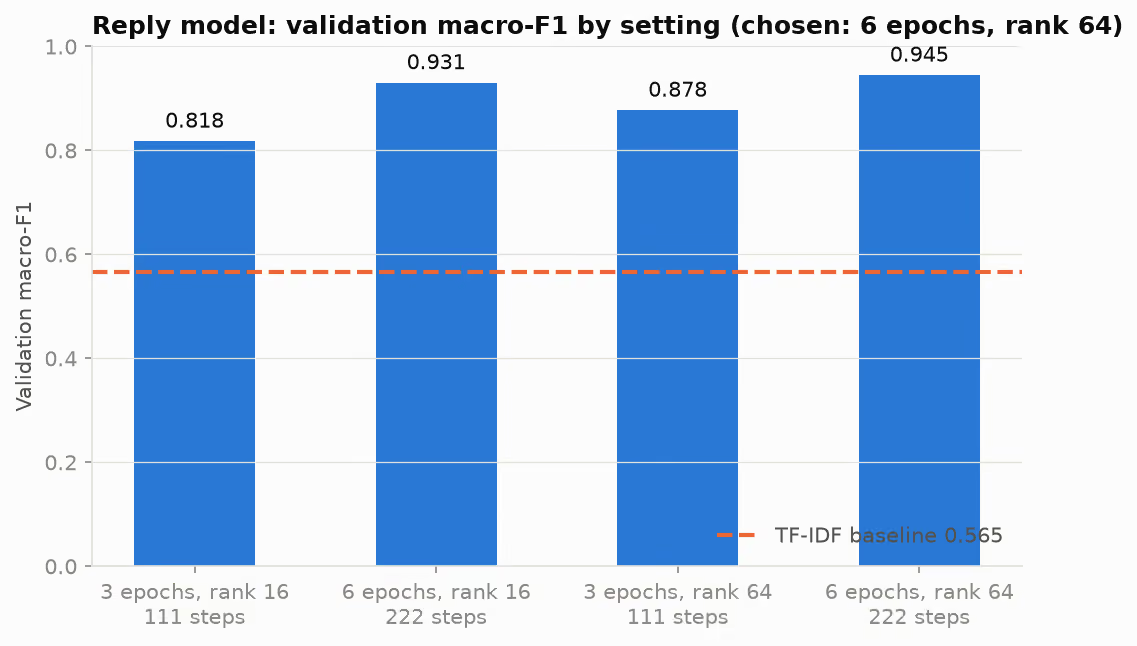
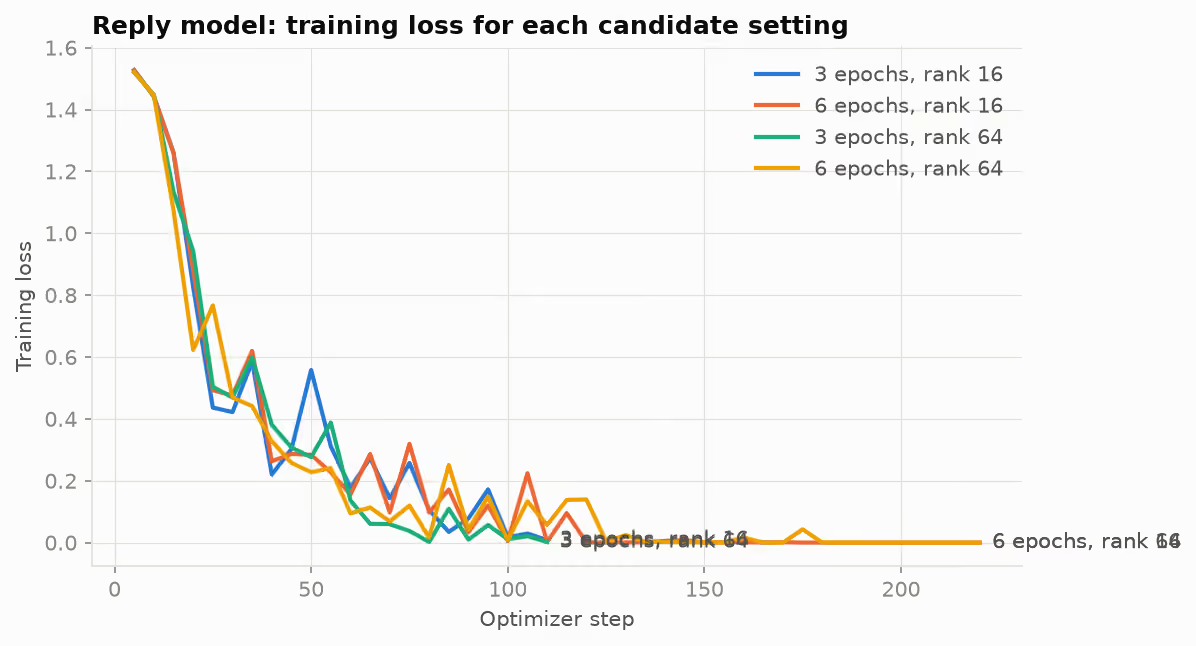
Six epochs beat three at both ranks, and rank 64 beats rank 16 at both epoch counts, so 6 epochs at rank 64 wins with 0.945. The loss curves alone do not pick the winner: the three-epoch runs also end near zero, yet they score lower on validation (0.818 and 0.878). More passes over the data helped the held-out score, not the training fit. The six-epoch runs fit their training replies completely, and the validation score, not the training loss, says whether that is overfitting. Here it is not.
Step 18: Calibrate and evaluate on validation
Section titled “Step 18: Calibrate and evaluate on validation”Each candidate was calibrated on the group-disjoint holdout inside train_reply_model. Unsloth’s evaluator gives the decision metrics over both questions:
reply_validation_metrics = FastDecisionModel.evaluate(    reply_model,    reply_tokenizer,    reply_validation_items,)
print(reply_validation_metrics)
{'accuracy': 0.967741935483871, 'ece': 0.019779227553836796, 'loss': 0.10463338459266519, 'record_accuracy': 0.9354838709677419}Per intent, with the follow-up question and the confusion matrix:
_predict_start = time.perf_counter()Per-intent validation metrics
FastDecisionModel.for_inference(reply_model)
reply_validation_predictions = predict_replies(    reply_validation_df,    reply_model,    reply_tokenizer,)
print(    classification_report(        reply_validation_df["reply_intent"],        reply_validation_predictions["reply_intent"],        labels=REPLY_INTENTS,        zero_division=0,    ))
validation_follow_up_labels = reply_validation_df["reply_intent"].map(    lambda intent: intent not in NO_FOLLOW_UP_INTENTS)
print(    "Follow-up decision metrics:",    classification_report(        validation_follow_up_labels,        reply_validation_predictions["follow_up_recommended"],        labels=[False, True],        zero_division=0,    ),)
print(    "Macro-F1:",    f1_score(        reply_validation_df["reply_intent"],        reply_validation_predictions["reply_intent"],        labels=REPLY_INTENTS,        average="macro",        zero_division=0,    ),)
print(    confusion_matrix(        reply_validation_df["reply_intent"],        reply_validation_predictions["reply_intent"],        labels=REPLY_INTENTS,    ))
precision recall f1-score support
interested 0.91 0.83 0.87 12meeting_requested 1.00 1.00 1.00 10 more_information 1.00 0.90 0.95 10 referral 0.92 1.00 0.96 12 not_now 0.91 0.91 0.91 11 objection 1.00 1.00 1.00 13 wrong_person 1.00 0.83 0.91 12 out_of_office 0.92 1.00 0.96 11 not_interested 1.00 1.00 1.00 11 opt_out 1.00 1.00 1.00 10 ambiguous 0.79 0.92 0.85 12
accuracy 0.94 124 macro avg 0.95 0.94 0.95 124 weighted avg 0.95 0.94 0.94 124[... 10 lines cut ...]Macro-F1: 0.9452537310827306[... 11 lines cut ...]mean_predict_ms = round((time.perf_counter() - _predict_start) * 1000 / len(reply_validation_df), 1)print("Mean milliseconds per reply prediction:", mean_predict_ms)Mean milliseconds per reply prediction: 75.6Macro-F1 gives each intent the same weight, which matters here because the intents that lead to different actions, such as not_now, not_interested and opt_out, are the ones a model mixes up most easily.
Step 19: Score the test set once
Section titled “Step 19: Score the test set once”Evaluate the chosen model on the test replies
reply_test_metrics = FastDecisionModel.evaluate(    reply_model,    reply_tokenizer,    reply_test_items,)
FastDecisionModel.for_inference(reply_model)
reply_test_predictions = predict_replies(    reply_test_df,    reply_model,    reply_tokenizer,)
print("Unsloth reply test metrics:", reply_test_metrics)
print(    classification_report(        reply_test_df["reply_intent"],        reply_test_predictions["reply_intent"],        labels=REPLY_INTENTS,        zero_division=0,    ))
reply_test_text_predictions = reply_text_baseline.predict(    reply_test_df["reply_text"])
print(    "TF-IDF test macro-F1:",    f1_score(        reply_test_df["reply_intent"],        reply_test_text_predictions,        labels=REPLY_INTENTS,        average="macro",        zero_division=0,    ),)
print(    classification_report(        reply_test_df["reply_intent"],        reply_test_text_predictions,        labels=REPLY_INTENTS,        zero_division=0,    ))
test_follow_up_labels = reply_test_df["reply_intent"].map(    lambda intent: intent not in NO_FOLLOW_UP_INTENTS)
print(    "Follow-up test metrics:",    classification_report(        test_follow_up_labels,        reply_test_predictions["follow_up_recommended"],        labels=[False, True],        zero_division=0,    ),)
print(    "Test macro-F1:",    f1_score(        reply_test_df["reply_intent"],        reply_test_predictions["reply_intent"],        labels=REPLY_INTENTS,        average="macro",        zero_division=0,    ),)
Unsloth reply test metrics: {'accuracy': 0.9758064516129032, 'ece': 0.01909714937210081, 'loss': 0.09047679677076949, 'record_accuracy': 0.9596774193548387} precision recall f1-score support
interested 1.00 1.00 1.00 13meeting_requested 1.00 1.00 1.00 11 more_information 1.00 1.00 1.00 10 referral 1.00 1.00 1.00 13 not_now 0.90 0.90 0.90 10 objection 1.00 1.00 1.00 12 wrong_person 1.00 1.00 1.00 12 out_of_office 1.00 1.00 1.00 10 not_interested 0.85 1.00 0.92 11 opt_out 1.00 0.90 0.95 10 ambiguous 1.00 0.92 0.96 12
accuracy 0.98 124 macro avg 0.98 0.97 0.97 124 weighted avg 0.98 0.98 0.98 124[... 1 line cut ...]TF-IDF test macro-F1: 0.7048601336254758[... 18 lines cut ...]Follow-up test metrics: precision recall f1-score support
False 0.88 1.00 0.93 21 True 1.00 0.97 0.99 103
accuracy 0.98 124 macro avg 0.94 0.99 0.96 124weighted avg 0.98 0.98 0.98 124[... 1 line cut ...]Test macro-F1: 0.9745960751681576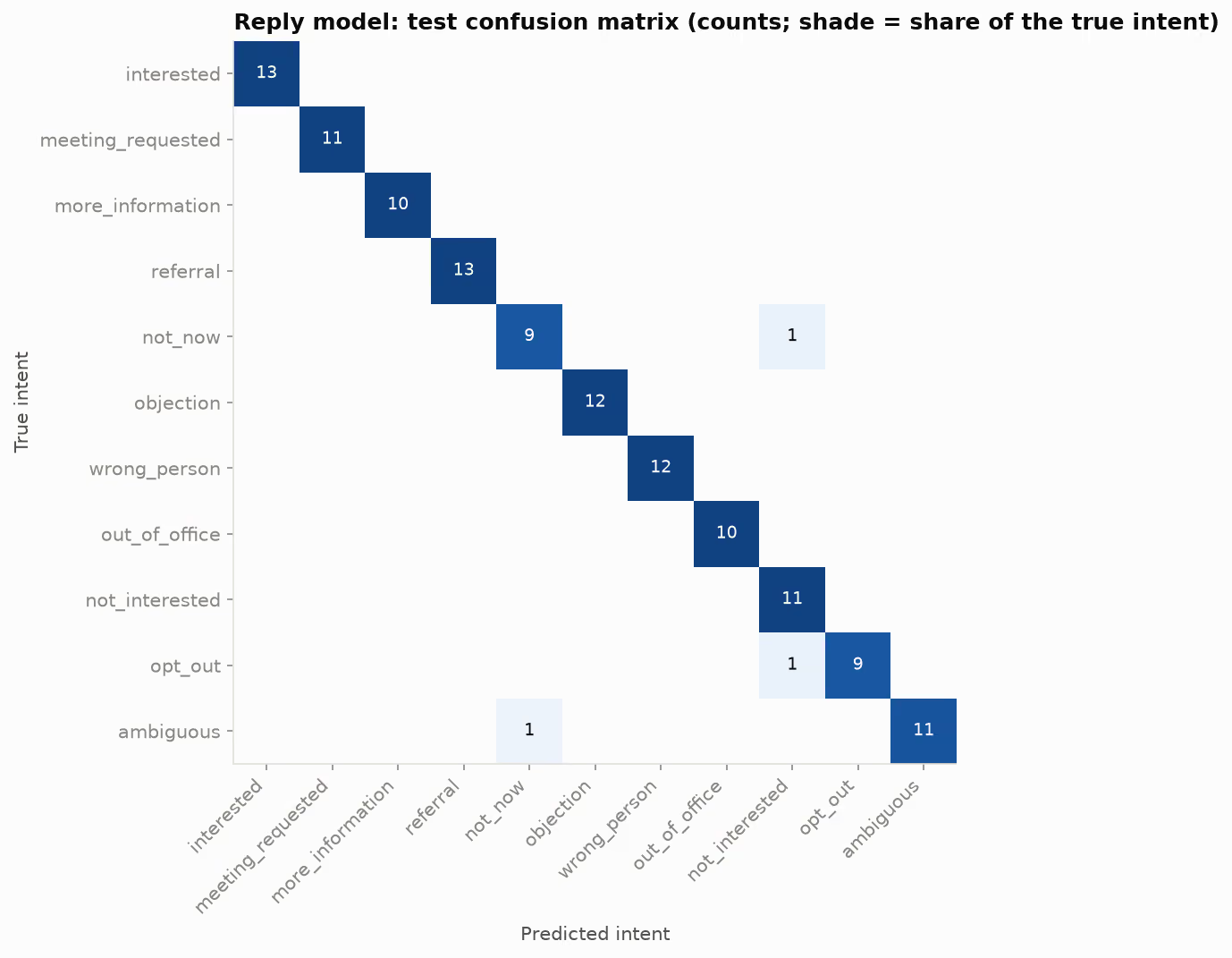
Three test replies are wrong. Two of them went to not_interested: one not_now reply and one opt_out reply. The opt-out error is the one that matters, because an opt-out must suppress marketing. So the routing in Step 20 suppresses every opt_out answer, and the gate of page 3 (Step 24) also looks for opt-out phrases in the text itself, whatever the model says.
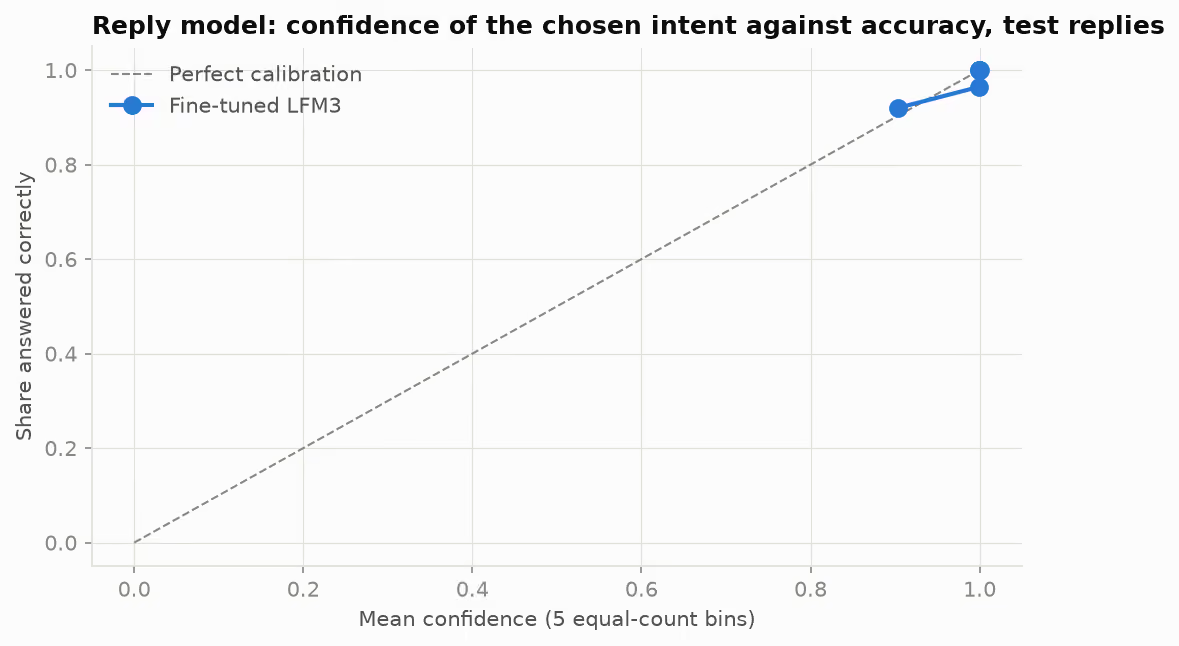
The confidence of the chosen intent is high for every test reply and matches the accuracy, so a confidence threshold would change little here. The plot cells:
Plot style
import matplotlib
matplotlib.use("Agg")import matplotlib.pyplot as pltfrom IPython.display import Image, display
SURFACE = "#fcfcfb"INK = "#0b0b0b"INK_SECONDARY = "#52514e"MUTED = "#898781"GRID = "#e1e0d9"SERIES = ["#2a78d6", "#eb6834", "#1baf7a", "#eda100"]FIGURES = Path("outputs/figures")FIGURES.mkdir(parents=True, exist_ok=True)
plt.rcParams.update(    {        "figure.facecolor": SURFACE,        "axes.facecolor": SURFACE,        "axes.edgecolor": GRID,        "axes.labelcolor": INK_SECONDARY,        "axes.titlecolor": INK,        "axes.titlesize": 12,        "axes.titleweight": "semibold",        "axes.titlelocation": "left",        "axes.grid": True,        "grid.color": GRID,        "grid.linewidth": 0.6,        "axes.spines.top": False,        "axes.spines.right": False,        "xtick.color": MUTED,        "ytick.color": MUTED,        "legend.frameon": False,        "legend.labelcolor": INK_SECONDARY,        "lines.linewidth": 2,        "font.size": 10,    })

def save_figure(figure, name):    path = FIGURES / f"{name}.png"    figure.savefig(path, dpi=150, bbox_inches="tight", facecolor=SURFACE)    plt.close(figure)    display(Image(filename=str(path)))    print("Saved", path)
from sklearn.calibration import calibration_curve
Draw the four figures and save the test predictions
reply_test_df[["reply_id", "reply_intent"]].reset_index(drop=True).assign(    predicted_intent=reply_test_predictions["reply_intent"],    confidence=reply_test_predictions["reply_intent_confidence"],    tfidf_intent=reply_test_text_predictions,).to_csv("outputs/reply-test-predictions.csv", index=False)
tfidf_validation_macro_f1 = f1_score(    reply_validation_df["reply_intent"],    reply_validation_text_predictions,    labels=REPLY_INTENTS,    average="macro",    zero_division=0,)figure, axis = plt.subplots(figsize=(8, 4.5))positions = range(len(reply_selection))values = [result["validation_macro_f1"] for result in reply_selection]bars = axis.bar(positions, values, width=0.5, color=SERIES[0])axis.bar_label(bars, labels=[f"{value:.3f}" for value in values], padding=4, color=INK)axis.axhline(tfidf_validation_macro_f1, color=SERIES[1], linewidth=2, linestyle="--", label=f"TF-IDF baseline {tfidf_validation_macro_f1:.3f}")axis.set_xticks(    list(positions),    [f"{result['epochs']} epochs, rank {result['lora_rank']}\n{result['optimizer_steps']} steps" for result in reply_selection],)axis.set_ylim(0, 1)axis.set_title(    f"Reply model: validation macro-F1 by setting (chosen: {reply_chosen['epochs']} epochs, rank {reply_chosen['lora_rank']})")axis.set_ylabel("Validation macro-F1")axis.legend(loc="lower right")axis.grid(axis="x", visible=False)save_figure(figure, "reply-epoch-choice")
figure, axis = plt.subplots(figsize=(8, 4.5))for result, color in zip(reply_selection, SERIES):    points = [(entry["step"], entry["loss"]) for entry in result["log_history"] if "loss" in entry]    label = f"{result['epochs']} epochs, rank {result['lora_rank']}"    axis.plot(*zip(*points), color=color, label=label)    axis.annotate(label, points[-1], xytext=(6, 0), textcoords="offset points", va="center", color=INK_SECONDARY)axis.set_title("Reply model: training loss for each candidate setting")axis.set_xlabel("Optimizer step")axis.set_ylabel("Training loss")axis.legend(loc="upper right")save_figure(figure, "reply-training-loss")
test_matrix = confusion_matrix(reply_test_df["reply_intent"], reply_test_predictions["reply_intent"], labels=REPLY_INTENTS)row_share = test_matrix / test_matrix.sum(axis=1, keepdims=True).clip(min=1)figure, axis = plt.subplots(figsize=(8, 7))axis.imshow(row_share, cmap=matplotlib.colors.LinearSegmentedColormap.from_list("blue", [SURFACE, "#cde2fb", "#6da7ec", "#2a78d6", "#104281"]), vmin=0, vmax=1)for true_index in range(len(REPLY_INTENTS)):    for predicted_index in range(len(REPLY_INTENTS)):        count = test_matrix[true_index, predicted_index]        if count:            axis.text(predicted_index, true_index, count, ha="center", va="center", fontsize=9, color="#ffffff" if row_share[true_index, predicted_index] > 0.5 else INK)axis.set_xticks(range(len(REPLY_INTENTS)), REPLY_INTENTS, rotation=45, ha="right")axis.set_yticks(range(len(REPLY_INTENTS)), REPLY_INTENTS)axis.set_xlabel("Predicted intent")axis.set_ylabel("True intent")axis.grid(False)axis.set_title("Reply model: test confusion matrix (counts; shade = share of the true intent)")save_figure(figure, "reply-confusion-matrix")
figure, axis = plt.subplots(figsize=(8, 4.5))correct = (reply_test_predictions["reply_intent"] == reply_test_df["reply_intent"].reset_index(drop=True)).astype(int)observed, predicted = calibration_curve(correct, reply_test_predictions["reply_intent_confidence"], n_bins=5, strategy="quantile")axis.plot([0, 1], [0, 1], color=MUTED, linewidth=1, linestyle="--", label="Perfect calibration")axis.plot(predicted, observed, color=SERIES[0], marker="o", markersize=8, label="Fine-tuned LFM3")axis.set_title("Reply model: confidence of the chosen intent against accuracy, test replies")axis.set_xlabel("Mean confidence (5 equal-count bins)")axis.set_ylabel("Share answered correctly")axis.legend(loc="upper left")save_figure(figure, "reply-calibration")
Reply model results
Section titled “Reply model results”The notebook writes every number to outputs/reply-metrics.json, including the validation score of every candidate.
| Measure | Split | Fine-tuned LFM3-1.7B | TF-IDF + logistic regression |
|---|---|---|---|
| Intent macro-F1 | Validation | 0.945 | 0.565 |
| Intent macro-F1 | Test | 0.975 | 0.705 |
| Intent accuracy | Validation | 0.94 | 0.57 |
| Intent accuracy | Test | 0.98 | 0.71 |
| Follow-up F1, “no next step” | Test | 0.93 | not applicable |
| ECE, both questions | Test | 0.019 | not applicable |
- Per intent on test. Seven intents score an F1 of 1.0. The other four are
not_now(0.90),not_interested(0.92),opt_out(0.95) andambiguous(0.96). - Spread between runs. The same notebook ran twice with seed 3407. The first run stopped in a cleanup cell after it scored the test set, and its chosen model scored 0.924 on test; the recorded second run scored 0.975. GPU kernels are not fully deterministic, and 124 test replies make one reply worth about 0.01 of macro-F1. Report a range, not a point, when you adapt this.
- Against the first version. The 20-step model of the first version scored 0.778 on the same test replies (its metrics), and its follow-up head answered yes for every reply. More optimizer updates fixed both.
- Cost. The chosen setting trained in 207 s; the grid took 711 s. Peak GPU memory was 4.6 GB. A prediction took 75.6 ms per reply on average.
Step 20: Map replies to actions
Section titled “Step 20: Map replies to actions”The model classifies; the application routes. route_reply maps the intent to a controlled action, and three rules come before the model: a suppressed contact, an explicit opt-out event or an opt_out answer always gives suppress_marketing; an unknown suppression status goes to verification; a malformed answer goes to human review. When the intent calls for a next step but the model’s follow-up answer is no, the reply goes to human review. Every branch returns send as False.
| Predicted intent | Action |
|---|---|
| interested, meeting_requested | Hand off to sales |
| more_information | Prepare the requested information for review |
| referral | Review the referral |
| not_now | Schedule later, after a person confirms the date |
| out_of_office | Pause until a person confirms the return date |
| objection, wrong_person, ambiguous | Human review |
| not_interested | Stop the sequence |
| opt_out | Suppress marketing |
The routing policy, route_reply
REPLY_ACTIONS = {    "interested": "handoff_to_sales",    "meeting_requested": "handoff_to_sales",    "more_information": "prepare_requested_information",    "referral": "review_referral",    "not_now": "schedule_later_after_date_confirmation",    "objection": "human_review",    "wrong_person": "human_review",    "out_of_office": "pause_until_return_date_confirmation",    "not_interested": "stop_sequence",    "opt_out": "suppress_marketing",    "ambiguous": "human_review",}
def route_reply(    predicted_intent,    model_follow_up_recommended,    contact_is_suppressed,    explicit_opt_out_event,):    if isinstance(contact_is_suppressed, np.bool_):        contact_is_suppressed = bool(contact_is_suppressed)    if isinstance(explicit_opt_out_event, np.bool_):        explicit_opt_out_event = bool(explicit_opt_out_event)
    if (        contact_is_suppressed is True        or explicit_opt_out_event is True        or predicted_intent == "opt_out"    ):        return {            "action": "suppress_marketing",            "model_follow_up_recommended": (                model_follow_up_recommended                if isinstance(model_follow_up_recommended, (bool, np.bool_))                else None            ),            "policy_follow_up_recommended": False,            "send": False,        }
    if (        contact_is_suppressed is not False        or explicit_opt_out_event is not False    ):        return {            "action": "verify_suppression_and_opt_out_status",            "model_follow_up_recommended": None,            "policy_follow_up_recommended": False,            "send": False,        }
    if not isinstance(model_follow_up_recommended, (bool, np.bool_)):        return {            "action": "human_review",            "reason": "invalid_follow_up_model_output",            "model_follow_up_recommended": None,            "policy_follow_up_recommended": False,            "send": False,        }
    model_follow_up_recommended = bool(model_follow_up_recommended)
    if predicted_intent not in REPLY_ACTIONS:        return {            "action": "human_review",            "reason": "unknown_reply_intent",            "model_follow_up_recommended": model_follow_up_recommended,            "policy_follow_up_recommended": False,            "send": False,        }
    policy_follow_up_recommended = (        predicted_intent not in NO_FOLLOW_UP_INTENTS    )
    if not policy_follow_up_recommended:        return {            "action": REPLY_ACTIONS[predicted_intent],            "model_follow_up_recommended": model_follow_up_recommended,            "policy_follow_up_recommended": False,            "send": False,        }
    if not model_follow_up_recommended:        return {            "action": "human_review",            "reason": "intent_and_follow_up_decisions_disagree",            "model_follow_up_recommended": False,            "policy_follow_up_recommended": True,            "send": False,        }
    return {        "action": REPLY_ACTIONS[predicted_intent],        "model_follow_up_recommended": True,        "policy_follow_up_recommended": True,        "send": False,    }
The classifier extracts no dates, names or requested items, so not_now and out_of_office wait for a person before anything is scheduled. Route the first validation reply:
sample_reply = reply_validation_predictions.iloc[0]
print(    route_reply(        predicted_intent=sample_reply["reply_intent"],        model_follow_up_recommended=sample_reply["follow_up_recommended"],        contact_is_suppressed=False,        explicit_opt_out_event=False,    ))
{'action': 'schedule_later_after_date_confirmation', 'model_follow_up_recommended': True, 'policy_follow_up_recommended': True, 'send': False}Regression checks for the policy gates
import numpy as np
assert route_reply(    predicted_intent="interested",    model_follow_up_recommended=True,    contact_is_suppressed=False,    explicit_opt_out_event=True,)["action"] == "suppress_marketing"
assert route_reply(    predicted_intent="interested",    model_follow_up_recommended=True,    contact_is_suppressed=None,    explicit_opt_out_event=False,)["action"] == "verify_suppression_and_opt_out_status"
assert route_reply(    predicted_intent="interested",    model_follow_up_recommended=False,    contact_is_suppressed=False,    explicit_opt_out_event=False,)["action"] == "human_review"
assert route_reply(    predicted_intent="interested",    model_follow_up_recommended="False",    contact_is_suppressed=False,    explicit_opt_out_event=False,)["reason"] == "invalid_follow_up_model_output"
assert route_reply(    predicted_intent="opt_out",    model_follow_up_recommended="invalid",    contact_is_suppressed=False,    explicit_opt_out_event=False,)["action"] == "suppress_marketing"
assert route_reply(    predicted_intent="interested",    model_follow_up_recommended="invalid",    contact_is_suppressed=np.bool_(True),    explicit_opt_out_event=np.bool_(False),)["action"] == "suppress_marketing"
integration/policy.py holds the same route_reply for page 3. There, the gate also looks for opt-out phrases in the reply text, and tests/test_gate.py checks that a mixed reply with an opt-out phrase, such as “Sounds useful, but please take me off your list”, is suppressed whatever the model answers.
Step 21: Save, publish and reload
Section titled “Step 21: Save, publish and reload”save_pretrained saves the adapter and the decision head; save_pretrained_merged exports a merged 16-bit model (Unsloth: calibrate and save).
reply_model.save_pretrained("outputs/reply-decision-adapter")reply_model.save_pretrained_merged( "outputs/reply-decision-merged", reply_tokenizer,)[... 6 lines cut ...]/home/dev/work/lead-decision-models/unsloth_env/lib/python3.13/site-packages/unsloth_zoo/saving_utils.py:3849: UserWarning: Unsloth: `LiquidAI/LFM3-1.7B` was loaded without a recorded commit, so its repo code was not copied into the export. Copy the repo's *.py files at the revision you loaded into `/home/dev/work/lead-decision-models/outputs/reply-decision-merged/.unsloth-save-6turp0u0` before loading it with trust_remote_code=True. warnings.warn([... 9 lines cut ...]Unsloth: Merge process complete. Saved to `/home/dev/work/lead-decision-models/outputs/reply-decision-merged/.unsloth-save-6turp0u0`As on page 1, Unsloth warns that it did not copy LFM3’s Python files into the export, and the merged folder still holds them in the recorded run. Check your own export before you load it with trust_remote_code=True.
REPLY_REPO = f"{HF_USERNAME}/lead-decision-models-reply-router"
if PUBLISH:    reply_model.push_to_hub(REPLY_REPO, reply_tokenizer)    reply_model.push_to_hub_merged(f"{REPLY_REPO}-merged", reply_tokenizer, save_method="merged_16bit")    print("Published", REPLY_REPO, "and", f"{REPLY_REPO}-merged")
[... 1 line cut ...]Unsloth: Saved the decision model to https://huggingface.co/raoofaltaher/lead-decision-models-reply-router[... 13 lines cut ...]Unsloth: Saved the decision model to https://huggingface.co/raoofaltaher/lead-decision-models-reply-router-mergedPublished raoofaltaher/lead-decision-models-reply-router and raoofaltaher/lead-decision-models-reply-router-mergedBoth Hub models fall under the LFM Open License v1.0. They are teaching models trained on synthetic replies. Release the training model, reload the merged export and compare one prediction:
import gc
del reply_model, reply_tokenizergc.collect()torch.cuda.empty_cache()
reloaded_reply_model, reloaded_reply_tokenizer = FastDecisionModel.from_pretrained( model_name="outputs/reply-decision-merged", trust_remote_code=True, max_seq_length=2048, load_in_4bit=LOAD_IN_4BIT,)
FastDecisionModel.for_inference(reloaded_reply_model)
reply_example = make_reply_record(reply_test_df.iloc[0])reply_reload_prediction = FastDecisionModel.predict( reloaded_reply_model, reloaded_reply_tokenizer, reply_example["state"], REPLY_QUESTIONS,)
print(reply_reload_prediction)
reply_before_export = reply_test_predictions.iloc[0]print( "Reply class agreement after export:", reply_reload_prediction["reply_intent"]["answer"] == reply_before_export["reply_intent"], reply_reload_prediction["follow_up_recommended"]["answer"] == bool(reply_before_export["follow_up_recommended"]),)[... 11 lines cut ...]{'reply_intent': {'type': 'choice', 'choice': 'interested', 'confidence': 0.9996, 'probabilities': {'interested': 0.9996, 'meeting_requested': 0.0, 'more_information': 0.0, 'referral': 0.0, 'not_now': 0.0, 'objection': 0.0, 'wrong_person': 0.0, 'out_of_office': 0.0, 'not_interested': 0.0, 'opt_out': 0.0, 'ambiguous': 0.0002}, 'answer': 'interested'}, 'follow_up_recommended': {'type': 'noul', 'noul': 0.9997, 'answer': True, 'probabilities': {'true': 0.9997, 'false': 0.0003}}}Reply class agreement after export: True TrueThe last cell writes outputs/reply-metrics.json and outputs/experiment-manifest.json, which records the base-model revision, the data checksums, the splits, the seeds, the chosen training settings and the package versions of both notebooks:
Write the metrics and the experiment manifest
import hashlibimport importlib.metadataimport platform
def installed_version(distribution):    try:        return importlib.metadata.version(distribution)    except importlib.metadata.PackageNotFoundError:        return None
reply_metrics = {    "model_id": MODEL_ID,    "model_revision": MODEL_REVISION,    "load_in_4bit": LOAD_IN_4BIT,    "splits": {        "optimizer_training": len(reply_fit_df),        "calibration": len(reply_calibration_df),        "validation": len(reply_validation_df),        "test": len(reply_test_df),    },    "baseline_untrained": reply_baseline,    "tfidf": {        "validation_macro_f1": float(f1_score(reply_validation_df["reply_intent"], reply_validation_text_predictions, labels=REPLY_INTENTS, average="macro", zero_division=0)),        "test_macro_f1": float(f1_score(reply_test_df["reply_intent"], reply_test_text_predictions, labels=REPLY_INTENTS, average="macro", zero_division=0)),    },    "epoch_selection": [{key: value for key, value in result.items() if key not in ("calibration", "log_history")} for result in reply_selection],    "chosen_epochs": reply_chosen["epochs"],    "calibration": reply_calibration_metrics,    "validation": {**reply_validation_metrics, "macro_f1": float(f1_score(reply_validation_df["reply_intent"], reply_validation_predictions["reply_intent"], labels=REPLY_INTENTS, average="macro", zero_division=0))},    "test": {**reply_test_metrics, "macro_f1": float(f1_score(reply_test_df["reply_intent"], reply_test_predictions["reply_intent"], labels=REPLY_INTENTS, average="macro", zero_division=0))},    "test_report": classification_report(reply_test_df["reply_intent"], reply_test_predictions["reply_intent"], labels=REPLY_INTENTS, output_dict=True, zero_division=0),    "follow_up_report": classification_report(test_follow_up_labels, reply_test_predictions["follow_up_recommended"], labels=[False, True], output_dict=True, zero_division=0),    "confusion_matrix": {"labels": REPLY_INTENTS, "matrix": confusion_matrix(reply_test_df["reply_intent"], reply_test_predictions["reply_intent"], labels=REPLY_INTENTS).tolist()},    "timings_seconds": TIMINGS,    "peak_vram_gb": peak_vram_gb,    "mean_predict_ms": mean_predict_ms,}Path("outputs/reply-metrics.json").write_text(json.dumps(reply_metrics, indent=2, default=float), encoding="utf-8")
lead_metrics = json.loads(Path("outputs/lead-metrics.json").read_text(encoding="utf-8"))
experiment_manifest = {    "experiment": "unsloth-b2b-lead-and-reply-decision-models",    "dataset": {        "leadforge_commit": lead_metrics["dataset"]["leadforge_commit"],        "leadforge_release": "v0.1.0-alpha",        "leadforge_tier": "intermediate",        "leadforge_task": "converted_within_90_days",        "lead_target_counts": lead_metrics["dataset"]["target_counts"],        "reply_dataset": "synthetic-llm-generated-automatically-checked",        "reply_dataset_sha256": reply_dataset_hash,        "reply_intent_counts": {key: int(value) for key, value in reply_df["reply_intent"].value_counts().items()},    },    "base_model": {"id": MODEL_ID, "revision": MODEL_REVISION, "load_in_4bit": LOAD_IN_4BIT},    "splits": {"lead": lead_metrics["splits"], "reply": reply_metrics["splits"]},    "seed": 3407,    "calibration_split_seed": 3408,    "training": {        "learning_rate": 2e-4,        "head_learning_rate": 1e-4,        "max_seq_length": 2048,        "lead": {"epochs": 2, "per_device_train_batch_size": 8, "gradient_accumulation_steps": 4, "lora_rank": 16, "lora_alpha": 16},        "reply": {"epochs": reply_chosen["epochs"], "per_device_train_batch_size": 8, "gradient_accumulation_steps": 1, "lora_rank": reply_chosen["lora_rank"], "lora_alpha": reply_chosen["lora_rank"]},    },    "timings_seconds": {**lead_metrics["timings_seconds"], **TIMINGS},    "peak_vram_gb": {"lead": lead_metrics["peak_vram_gb"], "reply": peak_vram_gb},    "runtime": {        "python": platform.python_version(),        "pytorch": torch.__version__,        "cuda_runtime": torch.version.cuda,        "gpu": torch.cuda.get_device_name(0),        "packages": {            name: installed_version(name)            for name in ["unsloth", "unsloth_zoo", "transformers", "bitsandbytes", "datasets", "pandas", "scikit-learn", "huggingface-hub"]        },    },    "policy_versions": {        "icp_policy": "fictional-procurement-icp-v1",        "reply_taxonomy": "b2b-reply-intents-v1",        "outreach_policy": "human-approval-and-external-suppression-v1",    },}
Path("outputs/experiment-manifest.json").write_text(json.dumps(experiment_manifest, indent=2, default=float), encoding="utf-8")print("Wrote outputs/reply-metrics.json and outputs/experiment-manifest.json")